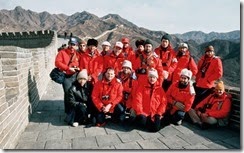
 I consider myself extraordinarily fortunate to have been a member of the 1984 Ultima Thule Everest Expedition. Things on Everest have changed radically since that climb and I don’t think an expedition to Everest like ours could happen today. Everything is far more commercialized now than it was than. Certainly the book “Seven Summits” by Dick Bass and Frank Wells really kicked off the guided “check book” mountaineering on the biggest peaks.
The other thing that has changed dramatically is China. The route we attempted was from north, the original route first attempted by the British in the 1920’s and the route where George Mallory and Andrew Irvine disappeared. In 1984, the reforms to the Chinese economy by Deng Xiaoping were still in their infancy. Western visitors to China were not common and the explosive growth in the economy were still a few years away.
The last thing is that the climbers on our trip, while certainly competent and sometimes very good, were not professional climbers (e.g., mountain guides). Very few of the members had ever climbed in the Himalayas. I think the efforts by the trips leaders, Warren Thompson, Ray Nichols and Tom Fitzsimmons to obtain the permit from the Chinese, negotiate the in-country logistics and obtain sponsorship for a considerable part of the expedition’s expenses were outstanding.
As it turned out, I was the last climber added to the expedition roster, only joining in autumn 1983. I owe my addition primarily to Jim Frush with whom I climbed Huascaran in 1982 and attempted Makalu II in 1983, and Don Goodman with whom I climbed Mt McKinley in 1981. Both were members of the expedition and advocated my application (side note: Jim and Don went back to Everest in 1988 organizing the climb that put the first American woman, Stacy Allison, on the summit). Additionally, as it turned out, I had climbed with Warren Thompson, the expedition leader, on a climb in the Washington Cascades 6 or 7 years previously and, apparently, had made a favorable impression.
It was a long trip, nearly 4 months, leaving Seattle in early February and returning early June. We traveled first to Beijing for several days and got to visit many, now common, sites such as the Great Wall and Forbidden City. Tiananmen Square, more than 5 years before the crackdown on protesters, was just a big open space in front of the Forbidden City which we casually walked across. When I see recent photos of these places they are usually filled with tourists. We typically were among the few foreign tourists visiting the sites and it felt uncrowded.
We next traveled to Lhasa in Tibet. We flew in on Boeing 707’s which were part of the first major USA trade activity with China after relations thawed during the 70’s. Lhasa is over 11,000 feet and the daytime temperature warm, as a result, the plane landed at a high rate of speed to keep lift. The rumor as to why the air field was 30-40 miles from Lhasa was security in case unrest broke out among the native Tibetans.
At the time, their was only one recently built tourist hotel which was in the dour, concrete style you expected of Communist regimes in that era. The highlights in Lhasa were the Potala, the chief residence for the Tibetan Buddhist Dalai Lama, and the old city of the Barhor.
Towards the end of February, we traveled by bus and flatbed truck for 3 days across the Tibetan Plateau to Everest Basecamp along the Rongbuk River at about 17,000 feet. Even though we had been in the high plains of Tibet for a week, we needed a while to acclimatize to the altitude, low humidity and dust. Respiratory ailments among the expedition members were common.
Only one other expedition was on the north side of Everest at the time, a British team composed of SAS (Special Air Services) members, equivalent to American special operations forces. They were attempting a difficult route up the north face of Everest but abandoned the climb after an avalanche killed a team member. Following their departure, we were the only people on that side of the mountain.
The climbing infrastructure on the Chinese side is very different that the Nepalese side. Instead of porters or sherpas to move our loads up the mountain, we used yaks to carry the majority of material from base camp to advanced base camp (21,000 feet). From there to the North Col camp at 23,000 feet, we did have a half dozen Tibetan porters carry gear but they went no further and relied on the route we established. To stock the two camps above 23,000 feet required our team members, whose rank was diminished significantly by health, to do the load hauling. My memory is not perfect but I think that only 7 to 8 of a total expedition team of 16 went above advanced base camp.
Ultimately, the load hauling grind wore the team down. We were climbing in a “heavy” style using oxygen pretty much above 23,000. The high point for the team by Greg Thompson and Tom Fitzsimmons was somewhat above 28,000, below the famous second step. Dave Hambly made a solo trip from high camp and probably was about the same altitude. My high point was a little over 26,200, the magic 8,000 meter mark.
 The trip back went pretty quickly. The onset of Spring had brought remarkable changes at base camp and the Tibetan plateau. The temperatures were mild and crops appearing in fields.
While as a climbing expedition, Ultima Thule was unsuccessful, as a personal adventure and trip, it was great and I am glad to have had the opportunity.
Team Members:
| Expedition | Members | Part-time Participants |
- Berg, Bob
- Clement, Tom
- Colpitts, Mike
- Fitzsimmons, Tom
- Frush, Jim
- Goodman, Don
- Hambly, Dave
- Hanson, Kurt
| - Hawkins, Phil
- Karuza, Anton
- Nichols, Ray
- Thompson, Greg
- Thompson, Warren
- Wohns, Rich
- Wolfe, Art
- Yaeger, John
| - Bauer, Gene
- Blackett, Ben
- Foutch, Rick
- Stamper, Mal
- Wiedman, Michael
- Wyckoff, Evan
|


