Tuesday, July 9, 2002

2002 – Grand Canyon Float Trip

Rafting the Grand Canyon had been on our trip list for a long time.  What brought it to the top of the queue in 2002 was seeing a trip with slots available that was accompanied by a string quartet that played concerts at camps in the evening and slot canyons along the way.  The trip was done once or twice a season by Canyon Explorations, one of the authorized river tour companies in Grand Canyon.

The trip certainly ranks up there as one of the best trips we’ve done.  The Grand Canyon is magnificent, words don’t do justice to it and photographs are only a pale representation of its grandeur.  The guides are supremely capable, personable and professional.  You can see that your enjoyment is their goal.  The NPS and guide companies do an excellent job of protecting the park yet still giving a large number of people the opportunity to enjoy the Grand Canyon with a measure of solitude.  You are camping but it is pretty benign and easily managed (a couple in the late 70’s was on our trip and had no difficulty).  The food was excellent and ample.

The trip started and ended in Flagstaff where, on day 1, we were transported by van to the put in point at Lees Ferry.  From there is was floating down the river in oar boats (large inflatable boats rowed by a guide) or paddle boat (smaller inflatable with 6-8 clients paddling while a guide steered the boat).  Along the way we’d stop periodically for hikes or an occasional concert.  At night we’d camp on shore and relax while some members of the quartet would play during dinner preparation.

The days in which a rapid was run was always one of excitement.  We didn’t have any boats overturn but did have some people ejected from their boats and pulled back in the quieter sections of the river.  On the more mellow rapids, some clients would paddle (or try to paddle) the inflatable kayaks (“duckies”) through them.

The rapids are not a frequent experience instead the days on the river are spent floating along, chatting with the guides and other clients.  We were there from the last week of June through the first week July so the temperature in the canyon bottom was warm.  As the guides would tell us, “if your hot, your stupid” because you have a wonderful cool bath right outside your boat that you jump into and float along with.

On day 15, 225 river miles later, we reached the take out point at Diamond Creek where the vans transported us back to Flagstaff and the start of the trip home.

Sunday, January 30, 2000

2000 – Baja Weekend

This was an “odd duck” sort of trip.  For some reason we had an Alaska Airlines credit which was going to expire if we didn’t use it.  Of course we managed to “save” that credit by spending more and buying a 3 or 4 day package tour to La Paz, Mexico on the Baja Peninsula.  We may have even turned in some additional miles and upgraded the air flight portion to first class (the memory is fuzzy, though).

No great adventure here but we did get to enjoy the warm sunny weather of Baja in January (a real treat coming from the grey Seattle weather) and drink our share of margaritas.  We did do a one day kayak tour which probably resulted in our signing up for a longer Baja kayak trip the following year.

Wednesday, December 1, 1999

1999 Annapurna Circuit

Marcia & I had organized long trips in the past, both foreign and domestic, but were beginning to appreciate having someone else do the hard work and worrying about details.  The Mountaineers to which we belonged had a program of foreign outings organized by its members.  One member, Craig Miller, had developed an expertise at organizing Nepal treks.  For the Fall of 1999, he was leading a 4+ week trek of the Annapurna Circuit with a side trip to the Annapurna South base camp.  In total it would be about 220 miles of walking.

1999-Annapurna-T-34xWith 10 members, this was the largest group we had travelled with since our 1985 Mexican Volcano trip.  With that many, there is always the opportunity to find someone with whom you don’t quite “click”.  Fortunately that was not the case and we had a great time on the trip.

We spent several days sightseeing in Kathmandu.  I was struck by how much it had changed from my previous visit in 1983.

We chartered a bus for the journey to the trek’s starting point at the village of Besisahar.  From there we started walking.  We had porters who carried most of our gear while we carried our water, snacks, cameras, valuables and items we need during the day.  Lunch would be at a tea house midway on the day’s route.  At day’s end we’d stop at a lodge and sleep indoors.

1999-Annapurna-R-16While our meals were in tea houses, we had our staff supervise the lodge’s kitchen to insure water was boiled and the food properly handled.  I don’t recall anyone having G.I. problems severe enough to jeopardize their trip.

The weather was generally quite nice although we had some cool mornings at the higher elevations along the route.  Fall is post monsoon and usually dry. 

The scenery is quite stunning and the route spans lush low lands at less than 3,000 feet elevation and a high mountain pass, Thorong La, at nearly 17,800 feet.  The schedule was leisurely and it allowed adequate time for everyone to reasonably acclimatize to the altitude.

After completing the trek, we stayed for several days in Pokhara, a lovely city on a beautiful lake with stunning views to the Himalayas beyond.  Unfortunately, I did not get to enjoy Pokhara as I was sick for a couple of days and stayed in our hotel room close to the toilet.

Return to Kathmandu was via a commuter aircraft.  From Kathmandu, the trip broke up with some people heading home, some going on a rafting trip and Marcia, myself and one other trek member heading down to the Bardiya National Park near the border with India.  We got our requisite elephant ride and went looking for tiger.  In retrospect, given the absence of any firearms carried by our guides, it was probably good that neither we nor a tiger found each other.

Our return to Seattle was uneventful except for our shock to hear about the rioting occurring on the downtown streets during the WTO conference the day we arrived.

Tuesday, April 20, 1999

1999 – Grand Staircase-Escalante

Over a number of trips, we had become smitten with the Southwest, especially in their relatively cooler times during Spring and Autumn.  The combination of blue sky, mild temperatures and lovely reddish rocks were a welcome change during the cold and dreary times in the PNW.

Marcia planned this trip as a car camping trip in the Grand Staircase-Escalante National Monument of Southern Utah interspersed with day hikes and short back pack trips.  We left Seattle in early April with our station wagon fully loaded for the two week trip.  Our first hurdle happened to be a late season ground blizzard which closed I-82 near Twin Falls in Idaho.  Fortunately conditions improved quickly and we resumed our drive taking US-93 towards Nevada and an overnight stop at a campground in the Great Basin National Park.  After a cold start the next morning, we took the Lehman Cave tour.

From there it was across the Great Basin of Nevada into Utah ending up at Kodachrome State Park. We picked up the incredibly scenic Utah SR-12 along the way and followed it to the Escalante Petrified Forest State Park.  This and the nearby community was our base for exploring the recently (1996) created Grand Staircase-Escalante National Monument.

Our main access to the area was down the Hole-in-the-Rock Road.  From there we did a day trip to Spooky and Peek-a-Boo Canyon and a multi-day trip to Harris Wash.  Nearby we did the Lower Calf Creek trail.  After our stay there we continued onto Capitol Reef National Park for a short visit.  It was in the town of Boulder just west of Capitol Reef that we heard about the horrific shootings at Columbine High School.

With the exception of the brief snow storm while driving through Idaho, the weather up to this point had been perfect.  But after Capitol Reef a wet front rolled in.  We had intended to stay at the Goblin Valley State Park but as we drove in the rains were pouring down and, only half jokingly, we feared that the hoodoos in the park would dissolve on top of us.  We started our journey home before our memories became tainted by camping in soggy conditions.

Monday, January 5, 1998

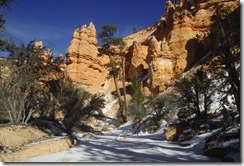
1998 – Bryce & Zion in January

For the 1997 Christmas Holiday, Marcia & I flew to Colorado Springs to celebrate with her family. We took our skis and camping gear because after Christmas, we and Marcia’s brother-in-law spent a few nights in huts operated by the 10th Mountain Division Hut Association. After returning to Colorado Springs, we flew to Las Vegas and drove a rental car to Bryce Canyon National Park.

The snow was sparse, so despite having ski equipment, we ended up doing a couple of hikes in the park. We certainly learned to love the gorgeous blue skies contrasting with the colorful rock you frequently find in the SW, even in the winter.

1998-AB-09   1998-AD-21

From Bryce we drove back to Zion National Park visiting both the northwestern Kolob Canyon area and the main Zion Canyon along the Virgin River. There was no snow here (although patchy ice in the north facing portions of Kolob Canyon) so we hiked in trail shoes. We even managed to get ourselves up the Angels Landing trail.

1998-AC-03  1998-BA-14

Tuesday, April 1, 1997

1997 Gates of the Arctic Ski Trip

Marcia and I had such a wonderful time on our 1996 ski trip to Gates of the Arctic National Park that we decided to do another one. We planned a different route, starting in Annatuvuk Pass (as we had in 1996) but ending at Bettles. We also recruited Craig Rowley with whom we had done several other trips with (e.g., 1988 Denali and 1992 Denali).

When our plane arrived in Annatuvuk Pass, it was either below zero or, at best, single digits above. It was also blowing a bit. Nevertheless, we started out south from Annatuvuk Pass aiming for the Inukpasugruk Creek drainage.

1998-AA-01The going was difficult because of the foot or more of unconsolidated snow we were having to break a trail through for ourselves and the sleds. When the sun dropped behind the ridge, the temperature really began to drop, and we made our first camp, perhaps 2 miles from Annatuvuk Pass.

I recall the temperature was 30 below by 5 pm that evening. The gas stove (MSR XGK) struggled against the cold to heat water. The candle lantern would not work because the flame could not melt the wax sufficiently to draw it up the wick. It was easily the coldest night I had ever experienced and showed the limits of the gear we had. The temperature recording device I had only went to 40 below, where it stayed all night long.

The next morning, we warmed the stove fuel bottle for a half-hour inside our sleeping bag before putting it on the stove and making breakfast. It was a unanimous decision to abort the trip at that point. To continue in that cold, with those trail conditions on a route we were unlikely see anyone, we felt was foolish. In retrospect, our 1996 trip might have been a fluke and not typical of spring skiing above the Arctic Circle.

1998-AA-10We headed back to Annatuvuk Pass. Fortunately, the NPS Ranger Station in town was manned and the ranger was kind enough to let us stay in a bunk room used by summer work crews (he probably figured that was easier than rescuing us or doing a report about our deaths).

We salvaged some fun from out trip by flying from Annatuvuk Pass to Bettles for a few days. We stayed at the Bettles Lodge, saw the Northern Lights and Comet Hale-Bopp and skied a few miles to Old Bettles. We joked about the trip being our “weekend ski trip to the Arctic Circle”.