Friday, May 20, 1988

1988 – Denali, Muldrow Traverse

The 1981 South Buttress traverse of Denali got me keen on seeing lesser visited areas of the mountain.  Even though the Muldrow Glacier on the NE corner of Denali was the only route climbed from 1913, the year of the first ascent, until 1951, the year the West Buttress was climbed, the Muldrow now comes in a distant second in popularity to the West Buttress.

One of the Muldrow’s drawbacks is its longer approach to the glacier before the climb begins. On the West Buttress, climbers land on the SE Fork of the Kahiltna Glacier at 7,200 feet and start from there.  For the Muldrow the start is from Wonder Lake at 2,100 feet and nearly 20 miles distant from the Muldrow Glacier. In addition, the McKinley River has to be crossed.  Depending on the river flow, that crossing is a major challenge.

Recruited for the trip were, besides Marcia & myself, Craig Rowley, Dave Sparks, Al Ellsworth and John Arnold.  To address the longer approach, we allowed for a 4 to 5 week climb and we hired a dog sledder to haul a substantial part of our gear to McGonagall Pass and the glacier.  We solved the McKinley River crossing by leaving early, the second week of April, when the river was frozen.  Since we were traversing the mountain and descending the West Buttress route, thus dodging a river crossing during the breakup or Spring floods.

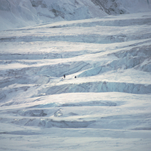
The climbing was not extremely technical but the route finding through crevasse fields kept us on our toes.  We took way too much food (my fault as I planned out much of the food) which slowed us down.  To keep our pack loads down yet get everything from camp to camp, took multiple trips.  We ended up dumping substantial amounts of food in crevasses along the way.  Even today I can’t look at Danish butter cookies without thinking of the tins that went into crevasses at 16,000 feet.  The good side of our slower pace was that none of us had any major altitude problems on the trip. 

While we failed to summit the peak on account of bad weather on our summit day from the 17,000 camp on the West Buttress, we did complete the traverse and dragged ourselves and oodles of gear over Denali Pass at 18,200 feet.  The climb lasted 34 days, and, with the exception of a National Park Service climbing team returning from Silver Throne (a nearby peak east of Denali), we saw no other climbers until we reached the 17,000 camp on the West Buttress, nearly 4 weeks of solitude. 
Thursday, January 22, 1987

1987 – Aconcagua/Argentina

1987-Aconcagua-037xThe 1987 Aconcagua trip was Marcia’s and my first foray into organizing an expedition. Joining us were fellow Mountaineer friends Craig Rowley, Bob Bergstrom and Larry Anzalone along with John Arnold and Scott Darsney, climbers that Bob knew and recommended from a previous trip.

1987-Aconcagua-097We planned for a 3-week trip flying from Seattle to Miami, Miami to Buenos Aires, Buenos Aires to Mendoza in one push. 1987 being before the current practice of airlines extracting revenue at every opportunity, we strove to get our many duffel bags onto the airplanes without paying excess baggage. One tactic was to demonstrate how light they were by having Marcia heft the bags onto the baggage scales. We figured the mostly male counter agents would assume that any bag hoisted by a female couldn’t be overweight.

1987-Aconcagua-099At the frontend of the trip we spent several days in Mendoza getting our permit (at the time, the Argentine government required all foreign climbers to present a doctor’s medical statement and an EKG) and supplies. Finding white gas for our stoves wasn’t possible so we ended up with paint thinner for our stoves (MSR XGK). That fuel later created problems as it repeatedly fouled the stove’s fuel jet and its fumes were noxious.

1987-Aconcagua-062Mendoza, though, was charming. The hotel we stayed at had a lovely courtyard in which we were able spread out our gear during the repack. The food and wine were excellent. Even today, I remember the meals featuring thick steaks and wonderful red wine.

Our original thought while in Seattle was to attempt the more difficult Polish Route rather than the Normal Route. After we arrived at the lodge (Penitentes) from which you choose the drainage to ascend, we quickly changed over to the much easier Normal route.

1987-Aconcagua-042It is a 2-day trip from the road to the base camp, Plaza de Mulas. While mules carry most of your equipment, they travel separately from you, so you must carry your personal and camping gear to be self-sufficient for the walk to basecamp.

1987-Aconcagua-006Once at basecamp, there are 3 intermediate camps before a summit attempt. To help with the acclimatization, you typically take at least 2 days between camp by carrying some gear to the next camp on one day, caching it, returning to the lower camp and then moving your camp on the second day.

1987-Aconcagua-015The Normal Route is not technical, but its challenges are the altitude, your health (i.e., avoiding respiratory or travel illnesses) and the weather. First Craig, then Larry turned back because of altitude issues. The difficulty in getting the stoves to reliably melt water while spewing noxious fumes from burning paint thinner probably contributed to Craig’s and Larry’s turning back.

1987-Aconcagua-011xOn our summit day, John, who was battling respiratory issues, turned back and Bob accompanied him back to camp. It was Scott, Marcia and myself who summited. We were the only people on that summit at the time but there was the body of a climber who had become disoriented on the summit in a white-out and died just a few days earlier.

1987-Aconcagua-068xThe trip out took a couple of days. Scott and John remained on the mountain (I think John subsequently summited). While Bob, Marcia & I returned to Mendoza. Larry had stayed at the hotel until our return while Craig returned home.

1987-Aconcagua-087The four of us (Larry, Bob, Marcia and I) toured Mendoza for a few days then returned to Buenos Aires. While Larry and Bob continued to the USA, Marcia and I detoured to the border of Argentina and Brazil where we visited Iguazu Falls. Afterwards we headed to Rio De Janeiro but by this time we were getting tired of carrying large duffel bags of outdoor gear through airports and headed for home rather than spend more time in Brazil.

Sunday, January 20, 1985

1985 – Mexican Volcanoes

1985-Mexico-C-006xThis turned out to be a pre-honeymoon for Marcia & I.  We became engaged in the Autumn of 1984 and scheduled our wedding for April 1985.  This trip to climb the 3 big Mexican volcanoes (Popocatepetl, Iztaccihuatl and Pico de Orizaba) near Mexico City was organized by our friends Roy & Peg Ellis. It was a large trip with eleven total (Roy & Peg Ellis, Bruce Pond, Bill Deters, Kathleen Sebastian, Ann Tibbets, Tamara McCollum, Chuck Coughran, Diane Hoff, Marcia & myself).

While the purpose was to climb the volcanoes, we did  tourist around Mexico City for a few days as acclimatization before trying the first two peaks (Popo & Ixta).  After the last volcano (Orizaba) we headed for a few days at the beaches of Puerto Vallarta.

Roy did a great job of organizing the trip and keeping us on track.  He was aided by having two trip members who spoke Spanish, Ann who had worked in Mexico for a period of time, and Bruce who was in Mexico already for an aid program.

We arrived in Mexico City the day after Christmas (1984) and it was real joy.  The holiday period extends from Christmas until Three Kings Day and the public places were all decorated.  Our hotel in Mexico City, Hotel Cortes, was a beautiful old style hotel across from major plaza.  It was 2 stories tall and its exterior was mostly solid and blank.  Inside there was a lovely open courtyard which all the rooms opened on to.  In the courtyard while enjoying an evening margarita, you could hardly hear the nearby traffic noise over the water cascading in the fountain. 

After Mexico City we drove in two rented VW microbuses to a lodge in the saddle between Popo and Ixta.  We did an acclimatization hike one day then left the next to climb Popo at 17,800 feet.  A few folks in our team weren’t feeling well on account of the altitude and had to turn back before the summit. 

A note on the “climbing”.  None of the routes we did required any technical gear or ropes.  We did use crampons in the morning on the frozen snow pack and carry ice axes for self arrest should you misstep and start to slide on the hard snow.

After a rest day at the lodge we took on Ixta.  People were getting more acclimatized and we all summited the 17,300 foot peak.

The last peak, Orizaba, is a half-day drive away from Popo and Ixta.  Additionally, we had to hire a local to drive us in a truck that last few miles to the climber’s hut at the base of the mountain on account of the road being too rough for the VW buses.  Orizaba is the highest peak in Mexico at 18,700 feet and the 3rd highest in North America (Mount McKinley in Alaska is 1st and Mount Logan in the Yukon is 2nd). Even though Orizaba is 900 feet higher than Popo, everybody was well acclimatized and summited.

It was time to vamos a la playa, so we were off to Puerto Vallarta for sun, sand and surf before returning to winter in the PNW.